550 5.7.26: the email is unauthenticated
The message failed the receiver's authentication checks, so it was refused. The fix is in your DNS: SPF, DKIM and a DMARC record that line up with your From domain.
Updated 4 min read
On this page (7)
550 5.7.26 is a permanent SMTP reply: failed SPF, DKIM or DMARC. This page is part of our SMTP error code reference, where every code links to the RFC and to what Gmail, Outlook and Yahoo publish about it.
- Kind
- Permanent: sending the same message again fails the same way
- Retry by hand
- No, fix the cause first
- In Mailbay
bounced, address not suppressed
What 550 5.7.26 means
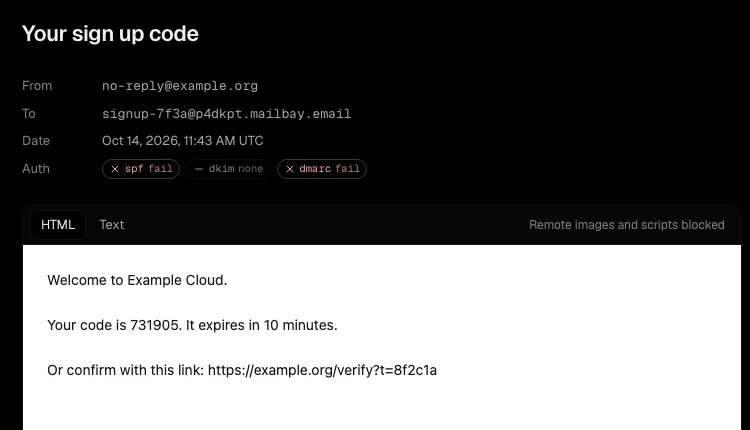
RFC 7372 registers X.7.26 as "Multiple authentication checks failed", returned "when a message failed more than one message authentication check" [2]. The basic code 550 makes it a permanent refusal [1].
In practice it means the receiver could not tie the message to its From domain with SPF or DKIM, and the domain's DMARC policy, or the receiver's own rules, say to refuse it.
What Gmail, Outlook and Yahoo say
- Gmail
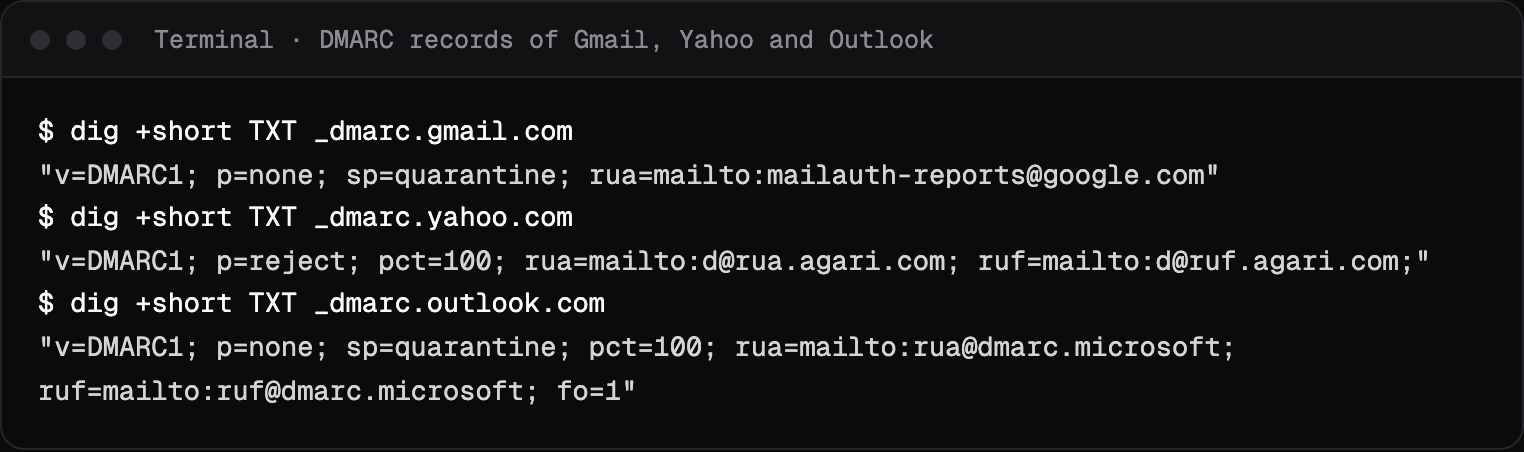
- "550 5.7.26 This email has been blocked because the sender is unauthenticated. Gmail requires all senders to authenticate with either SPF or DKIM." Two other 550 5.7.26 rows cover an SPF hard fail and a domain whose DMARC policy rejects [3]. Since February 1, 2024, all senders need SPF or DKIM, and senders of more than 5,000 messages a day need SPF, DKIM and DMARC [4].
- Yahoo
- Does not list 5.7.26, but requires SPF or DKIM from every sender, and from bulk senders "a valid DMARC policy with at least p=none - DMARC must pass" [5].
- Outlook and Microsoft 365
- Uses the temporary 4.7.26 for mail over IPv6 that "must pass either SPF or DKIM validation" [6], and 550 5.7.515 for high volume senders without SPF, DKIM and DMARC.
Sources, read on October 14, 2026
- [1]RFC 5321, Simple Mail Transfer Protocol, section 4.2: www.rfc-editor.org/rfc/rfc5321#section-4.2
- [2]RFC 7372, Email Authentication Status Codes: www.rfc-editor.org/rfc/rfc7372
- [3]Google, Gmail SMTP errors and codes: knowledge.workspace.google.com/admin/support/troubleshooting/gmail-smtp-errors-and-codes
- [4]Google, Email sender guidelines: support.google.com/a/answer/81126
- [5]Yahoo Sender Hub, best practices: senders.yahooinc.com/best-practices/
- [6]Microsoft Learn, Email non-delivery reports and SMTP errors in Exchange Online: learn.microsoft.com/en-us/troubleshoot/exchange/email-delivery/ndr/non-delivery-reports-in-exchange-online
Prices change. If something here is out of date or wrong, email hello@mailbay.dev and we will fix it.
Common causes
- No DKIM signature, or a signature for a domain other than the one in From.
- An SPF record that does not include the service actually sending your mail.
- Two SPF records on one domain, which makes SPF fail with an error.
- A DMARC policy of quarantine or reject while SPF and DKIM do not align with the From domain.
- Forwarding, which breaks SPF; DKIM is what survives it.
How to fix it
- Send through a provider that signs with DKIM for your own domain, and publish its DKIM record.
- Publish one SPF record that includes every service that sends as your domain. To merge two, see SPF, DKIM and DMARC explained.
- Publish a DMARC record, starting with
p=noneand a report address, then tighten it once reports show everything passing. - Send a test email to the free deliverability test to see which of SPF, DKIM and DMARC fails and how to fix it, or send one to a Gmail address and open "Show original".
How Mailbay reports it
When a recipient's server answers 550 5.7.26 to mail you send through Mailbay, the recipient becomes bounced and you get a message.bounced event with the server's reply in response and permanent: false. The message statuses page lists every state.
A policy refusal says nothing about whether the address exists, so Mailbay does not suppress it, and it does not count toward the automatic pause, which only counts hard bounces and spam complaints.
When you add a domain, Mailbay generates the SPF include, a DKIM key with the selector mb1 and a DMARC record, checks each one live and merges an existing SPF or DMARC record instead of replacing it (domain setup). Mail you send from a verified domain is DKIM signed for that domain, which is the alignment Gmail looks for.
Mailbay checks incoming mail the same way: every received message shows its SPF, DKIM and DMARC results in the dashboard and in the API's auth_results.
Related codes
- 550 5.7.515: sender rules at Outlook.com, permanent.
- 550 5.7.25: no reverse DNS for the IP, permanent.
- 550 5.7.1: refused for a policy reason, permanent.
- 421 4.7.0: temporary refusal, connection closed, temporary.
- 550 5.1.1: mailbox does not exist, permanent.
Seeing an API error rather than an SMTP code? Mailbay's own errors, each with a fix, are on the errors page.
Questions
Does 550 5.7.26 mean my domain is blacklisted?
No. It means this message failed authentication. Fix SPF and DKIM for the domain in your From address, add DMARC, and the same mail is accepted again.
Is p=none enough for Gmail?
Google's guidelines accept a DMARC policy of p=none for senders of more than 5,000 messages a day, as long as SPF and DKIM are set up and the From domain aligns with one of them.
Why did forwarded mail get 550 5.7.26?
Forwarding sends the message from the forwarder's server, so SPF no longer matches the original domain. A DKIM signature survives forwarding when the message is not changed, which is why DKIM matters most.
Read next
- 550 5.7.515: access denied by Outlook.comOutlook.com, Hotmail and Live refuse mail from high volume senders whose domain lacks SPF, DKIM and DMARC. The bounce names the domain that has to be fixed.
- 550 5.7.25: reverse DNS check failedThe receiving server looked up the name of the IP address your mail came from and found none, or found one that does not resolve back to that IP.
- SMTP error codesWhat a bounce or deferral code means, what Gmail, Outlook and Yahoo say about it in their own words, and how to fix it. Each page shows a real SMTP session.
Join the beta
Mailbay is in private beta and free while the beta runs: inboxes, sending, your own domains and MCP. We invite people in small batches and read every note on the form.